

When it comes to marble vs granite -and engineered stone- there is no universally superior material.
We know that isn’t the answer most people are looking for when they’re trying to choose between the three. We would all love one material that is simply the best and call it a day.
Unfortunately, projects don’t work that way.
The right material depends on what the project actually needs.
A luxury hotel lobby may care more about visual character than anything else. A busy commercial space may prioritise durability and maintenance. A large residential development may care more about consistency, cost, and whether hundreds of surfaces can look the same.
Marble, granite, and engineered stone can all work. They just solve different problems.
Where Do These Materials Come From?
Marble and granite are natural stones, but they don’t share the same geological process.
Heat and pressure form marble over time, transforming limestone into a stone known for veining, movement, and variation; no two natural slabs are ever completely identical.
Granite is an igneous rock formed from cooled magma. Its dense structure makes it particularly well suited to applications where resistance to everyday wear matters; which is one reason we quarry and finish so much of it for flooring, cladding, and staircases.
Engineered stone is different. Manufacturers make it using natural quartzine, marble, or granite powder combined with binders and other materials. Because it’s manufactured rather than quarried as one natural block, its appearance and consistency can be controlled much more closely.
That difference matters once you start thinking about what you actually need from the material.
Marble vs Granite: Which One Is More Durable?
If durability is your main concern, granite is usually the natural stone I’d look at first.
It generally offers strong resistance to scratching, heat, and heavy everyday use, which makes it a practical choice for demanding environments (we go into more detail on this in why granite suits high-traffic areas).
Marble requires more care. It scratches more easily than granite, and acidic substances can etch or dull its surface over time.
That doesn’t mean marble can’t be used in high-use spaces. It means the specification, finish, installation, treatment, and maintenance plan need to account for its characteristics if a project chooses marble because its appearance is important.
Engineered stone can also perform well in everyday use, particularly when stain resistance and easy maintenance are priorities. But its performance around high heat can vary; resin-based materials generally aren’t as heat-resistant as natural stone, so the intended application matters here too.
In other words, asking which material is “most durable” isn’t quite enough. You also need to ask: durable against what? Scratches? Heat? Staining? Heavy traffic? Acids? Daily wear? The answer changes depending on the question.
What About Appearance?
This is where natural stone becomes difficult to replace.
A natural block has spent millions of years becoming what it is. Its veins, mineral deposits, colors, and movement are the result of its geological history. You can choose a particular type of marble or granite, but you can’t fully control what nature put inside that block.
For some projects, that’s exactly the point.
A feature wall in a luxury hotel doesn’t necessarily need every slab to look identical. Too much consistency can even take away from what makes the material special in the first place.
But what if you’re working on a large residential development and need hundreds of surfaces to look as similar as possible? Then consistency becomes an advantage, and this is one of the areas where engineered stone can make a lot of sense. Its manufacturing process allows much greater control over appearance, which is valuable when predictability matters more than natural variation.
Neither approach is inherently better. One gives you uniqueness. The other gives you consistency. Our guide on choosing the right stone for your project walks through how to weigh that trade-off in practice.
What About Maintenance?
This is where the differences become much more practical.
Granite is generally low maintenance, though depending on the specific stone and application, sealing may still be recommended.
Marble needs more attention. Appropriate sealing, care around acidic substances, and periodic maintenance all help keep the surface in good condition, particularly in high-use applications (our guide to marble and granite finishes covers how the finish you pick affects this).
Engineered stone is generally easy to maintain and resists many common stains without requiring sealing.
But there’s an important caveat: the material name alone doesn’t tell you everything. The specific stone, finish, installation method, intended use, and manufacturer’s recommendations all matter. A material can look good on paper and still be the wrong choice for a particular application.
And What About Sustainability?
This question is becoming increasingly important, and there isn’t a one-word answer here either.
Quarries extract natural stone rather than manufacture it from resin-bound composites, and a properly selected natural stone can have a very long service life. It can also potentially be reused or repurposed after its original installation, a point the Natural Stone Institute’s sustainability program covers in more depth, and one we explored in Natural Stone: Crafting Sustainable Architecture for Tomorrow.
Engineered stone has different characteristics because its manufacturing process and composition differ, including the presence of binders and other materials.
So when a project is trying to make a more environmentally responsible choice, “which material is greener?” is probably too simple a question.
A better one is: “What do we know about this particular material?” Where was it extracted? How was it processed? How far does it need to travel? What is it made from? How long is it expected to last? Can it be reused? What happens to it at the end of its service life?
For projects pursuing environmental certifications, these details matter far more than a “natural” or “engineered” label.
And Then There Is Cost
This is where things get complicated quickly.
The price of a material depends on much more than the material itself. The specific stone, origin, finish, quantity, fabrication requirements, dimensions, packaging, transportation, and logistics can all affect the final cost, and this becomes particularly important for large export orders.
If you’re buying natural stone at scale, working with a quarry-linked supplier can reduce the number of intermediaries between extraction, processing, and the finished product. That doesn’t automatically make one material cheaper than another. It does mean that comparing only the price of a slab gives you a very incomplete picture.
The number that matters is the complete delivered cost.
Marble vs Granite: So, Which One Should You Choose?
If you’re working on a high-traffic project where durability and maintenance are major concerns, granite or an engineered material may make more sense.
If you’re designing a luxury lobby, feature wall, or another space where visual impact is the priority, marble may be worth the additional care.
If you’re working on a large residential development where consistency, maintenance, and budget matter, engineered stone may be the better fit. Carefully selected natural stone can also work when its variation is acceptable or desirable.
Sometimes the answer isn’t one material; different areas of the same project can have different requirements. There’s no universal winner, only the material that makes the most sense for your project.
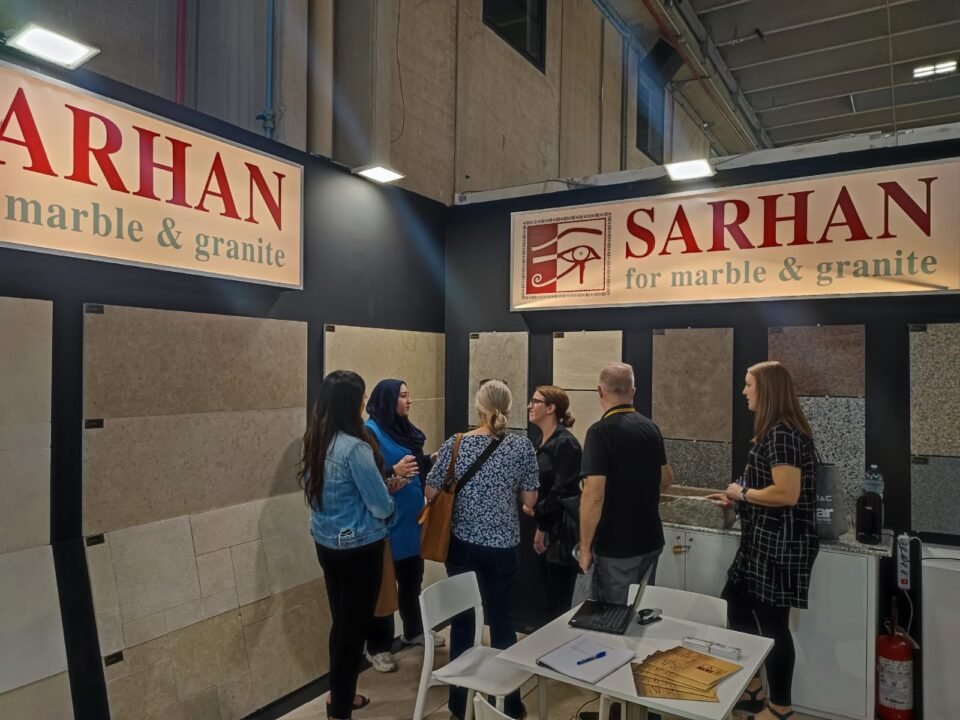
At Sarhan for Marble & Granite, we work with architects, designers, and buyers to evaluate materials, finishes, samples, specifications, and project requirements before production. Our supply chain covers natural stone from quarry through manufacturing and into custom finished products.
So before you finalize a specification, don’t just ask which material looks best. Ask what the project needs. Then choose accordingly.
 English (UK)
  Français
  Español